What if supporting your gut microbiome is not simply about adding “good bacteria,” but also about creating the right environment for them to function?
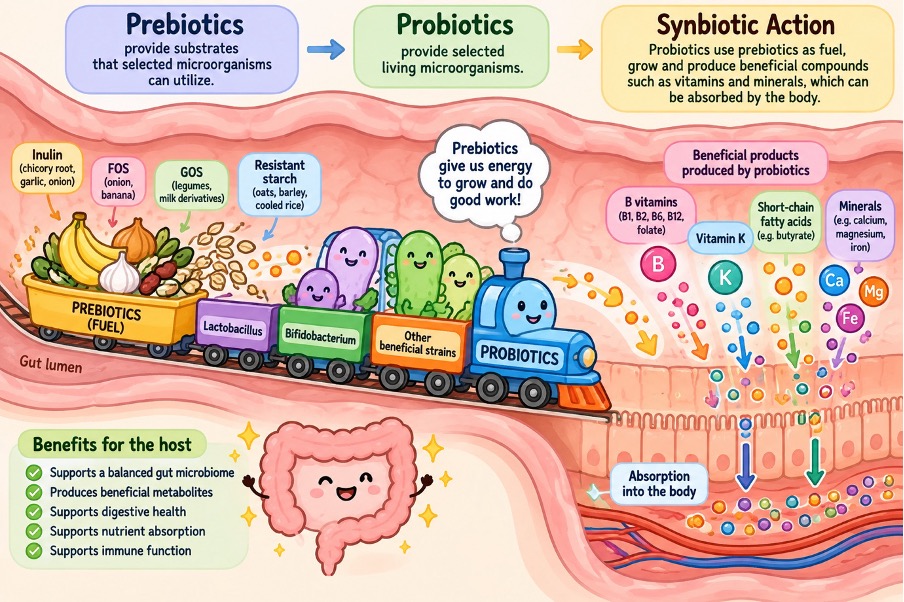
We often hear that probiotics are the good bacteria, while prebiotics are their food. That's a useful introduction, but the science is more interesting. A probiotic provides a specific live microorganism with a demonstrated health benefit. A prebiotic provides a substrate that selected microorganisms can utilise. When these components are deliberately combined, and the combination provides a health benefit, it is known as a synbiotic (Gibson et al., 2017; Hill et al., 2014; Swanson et al., 2020).
A simple way to remember the relationship is:
Probiotic = the microorganism.
Prebiotic = the fuel.
Synbiotic = the purposeful partnership.
Meet the Gut Microbiome
Our gastrointestinal tract is home to a complex community of microorganisms. These microorganisms interact with one another, with food, and with our body. Their composition varies throughout the digestive tract because different regions have different environmental conditions. Microorganisms generally become more abundant toward the large intestine, where fermentation of dietary substrates is particularly important (Slavin, 2013).
What Exactly Is a Probiotic?
Probiotics are live microorganisms that, when administered in adequate amounts, confer a health benefit on the host (Hill et al., 2014). This definition matters because not every bacterium found in a food is automatically a probiotic. A probiotic microorganism needs appropriate identification, safety, viability, and evidence for a health benefit.
And one word matters enormously: strain.
Different strains can have different characteristics and effects. Evidence supporting one probiotic strain cannot automatically be applied to another strain of the same species (Hill et al., 2014). So seeing “probiotic” or “live cultures” on a label does not, by itself, tell us what health benefit a product will provide.
What Is a Prebiotic?
A prebiotic is a substrate selectively utilised by host microorganisms that provides a health benefit (Gibson et al., 2017). The concept was first proposed in 1995 and has been refined since (Gibson & Roberfroid, 1995; Gibson et al., 2004). This is why prebiotics are often described as food for beneficial bacteria. There is an important refinement: prebiotics are not simply food for probiotic supplements. Selected microorganisms already present in the gut can use them. Rather than thinking only about feeding bacteria we consume, it is better to think about supporting selected microbial activities within the existing ecosystem.
Why the Right Combination Matters
Different microorganisms have different metabolic capabilities. A prebiotic that one microorganism can use may not affect another the same way (Hutkins et al., 2016). Therefore, researchers are increasingly interested in matching specific microorganisms with appropriate substrates (Gomez Quintero et al., 2022). The important question is not simply, “Can I take a probiotic and a prebiotic together?” It is: “Is this particular probiotic compatible with this particular substrate, and does their combination provide a demonstrated health benefit?”
That distinction is at the heart of synbiotic research.
What Is a Synbiotic?
A synbiotic is a combination of live microorganisms and selectively utilised substrates that provides a health benefit (Swanson et al., 2020). Simply putting a probiotic and fibre into the same capsule or food does not automatically make it a scientifically established synbiotic. Synbiotics can broadly be considered complementary or synergistic. A complementary synbiotic combines a probiotic and a prebiotic, where each component meets the minimum criteria for a probiotic or a prebiotic (Swanson et al., 2020). A synergistic synbiotic is designed so that the substrate is specifically intended to be utilised by the co-administered microorganism, with the combination demonstrating a health benefit (Swanson et al., 2020).
The real question is whether the two components work together measurably and beneficially.
Examples of Combinations
Bifidobacterium + Inulin
One example is a defined Bifidobacterium strain with inulin. Inulin is a fructan found naturally in foods such as chicory root, garlic, and onions (Slavin, 2013). Certain microorganisms can utilise inulin-type fructans (Gibson et al., 2017). These combinations can be investigated to pair a defined microorganism with a suitable substrate.
Probiotic + FOS
Fructooligosaccharides (FOS) are fermentable carbohydrates that selected microorganisms can utilise, and they have been investigated for their effects on the gut microbial community (Gibson et al., 2017). Combining FOS with a selected probiotic offers another way to study microorganism–substrate interactions.
Probiotic + GOS
Galactooligosaccharides (GOS) are another important group of prebiotic substrates. They have been studied for their ability to influence selected groups of gut microorganisms (Gibson et al., 2017). Combining GOS with a selected probiotic offers another opportunity to investigate whether the two can work together.
Probiotic + Resistant Starch
Resistant starch escapes digestion in the small intestine and reaches the colon, where microorganisms can ferment it (Slavin, 2013). It occurs in foods such as legumes and some cooked-and-cooled starchy foods. It can therefore serve as an interesting substrate for studying gut microbial interactions.
Everyday Prebiotic Foods
Many prebiotic substrates occur naturally in familiar foods (Slavin, 2013). Garlic and onions contain fructan-type carbohydrates. Chicory root is a rich source of inulin. Bananas provide fermentable carbohydrates, with their composition changing as they ripen. Beans, chickpeas, and lentils provide fibre and fermentable carbohydrates. Oats and barley provide fibre and other carbohydrates that interact with the gut microbiota.
The goal is not to find one “perfect” prebiotic food. Dietary diversity matters because different foods provide different fibres and substrates, creating a broader nutritional environment for the microbial ecosystem.
Does Every Probiotic Need a Prebiotic?
No—not necessarily.
A probiotic can have a demonstrated health benefit without being consumed with a prebiotic. However, selected probiotics may benefit from compatible prebiotic substrates, and carefully designed combinations may provide additional or synergistic benefits (Gomez Quintero et al., 2022; Swanson et al., 2020). Therefore, saying “every probiotic needs a prebiotic to work” is too broad. A more scientifically defensible statement is:
Selected probiotics may benefit from compatible prebiotic substrates, and specific combinations may provide health benefits when evidence supports them.
Why More Is Not Always Better
A probiotic containing more strains or a higher number of microorganisms is not automatically superior. Similarly, adding more prebiotic does not necessarily make a product more effective. What matters is the right strain, appropriate dose, suitable substrate, product stability, and demonstrated health outcome.
The goal is not to maximise bacteria and fibre. The goal is to create the right combination.
The Take-Home Message
The relationship between probiotics and prebiotics is not simply a story about “good bacteria” and “food for bacteria.” It is a story about partnership.
- Probiotics provide selected living microorganisms.
- Prebiotics provide substrates that selected microorganisms can utilise.
- Synbiotics combine these components in a scientifically purposeful way to deliver a health benefit.
The most important lesson is that compatibility matters. Not every probiotic uses every prebiotic, not every combination is synergistic, and not every product marketed as synbiotic has the same level of evidence.
So rather than thinking, “I need more probiotics,” think:
“What microorganism am I providing, what substrate can support the relevant microbial activity, and is there evidence that this combination benefits health?”
The probiotic brings the microorganism. The prebiotic provides the fuel. The right combination may create a purposeful partnership. And perhaps that is the most fascinating lesson: we are not simply feeding ourselves; we are also creating an environment for an entire microbial ecosystem living within us.